Chapter 3 · Q005 to Q009
The loader
The PowerShell command unpacked a bundle with tar and ran QuickConnectSupport.exe. In this chapter I follow what tar wrote, check what that executable really is, and find what it started.
What did tar write? Q005
Sysmon event 11 records file creation. Filter to the files tar.exe wrote:
event_id="11" image=$"\\tar.exe" | sort(timestamp) | table(timestamp, computer_name, user, target_file)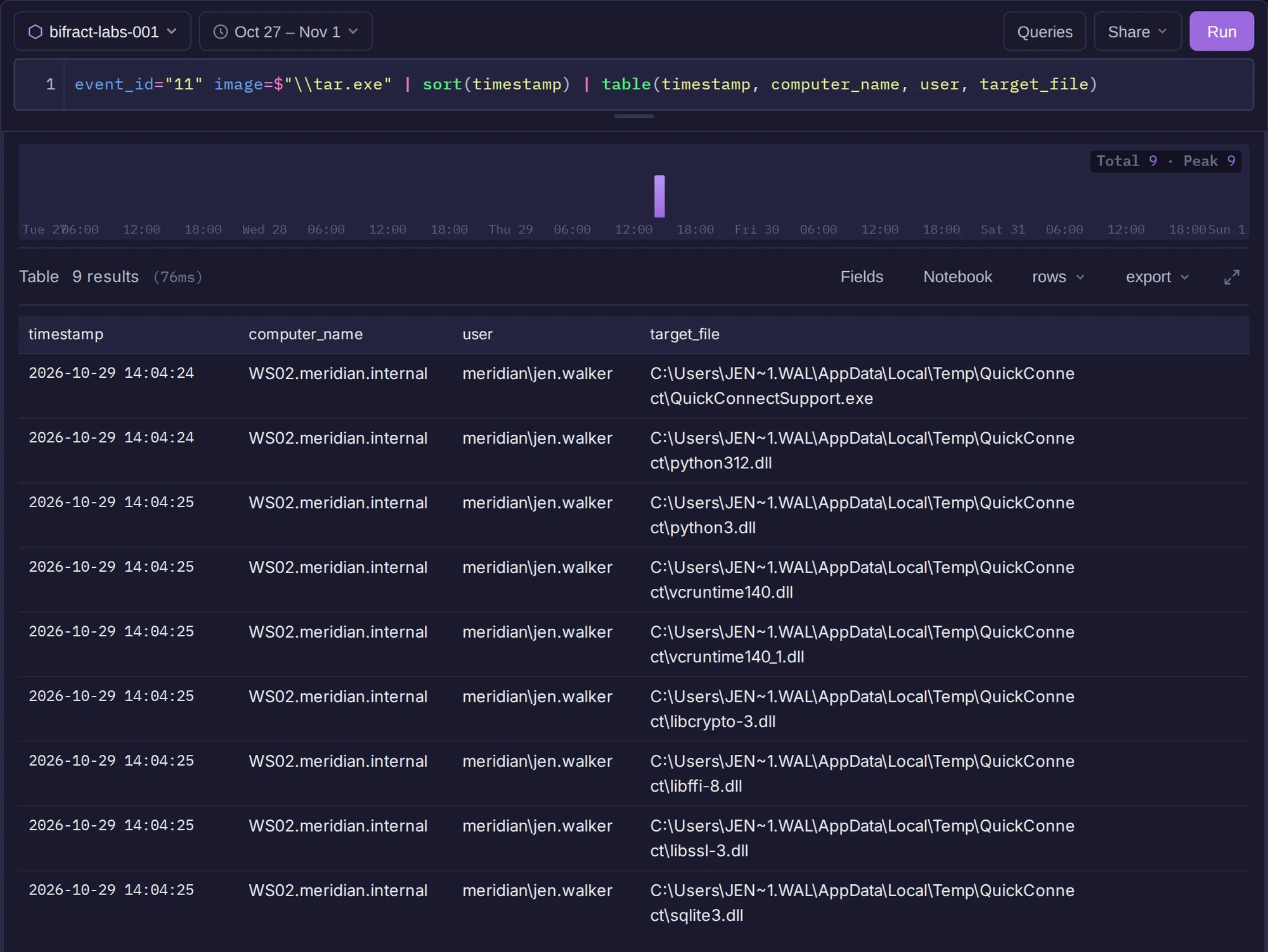
Files tar created in the user's Temp folder.
The first file is ...\Temp\QuickConnect\QuickConnectSupport.exe, followed by python312.dll, python3.dll, vcruntime140.dll and the rest of a Python runtime.
Finding · Q005
The loader was written to disk as QuickConnectSupport.exe.
Two files, one name
A second, different QuickConnectSupport.exe shows up later in AppData\Local\Programs\QuickConnect Support\. Filter on \Temp\QuickConnect\ to stay on the loader. The user folder also shows up in its 8.3 short form, JEN~1.WAL, so match on \Temp\QuickConnect\ instead of the user name.
What is it really? Q006
Windows executables carry an OriginalFileName in their version info, and Sysmon records it. When it doesn't match the name on disk, the file was renamed.
bifract_category="process_creation" image=~"\\Temp\\QuickConnect\\" | sort(timestamp) | table(timestamp, image, original_file_name, company, trusted, process_guid)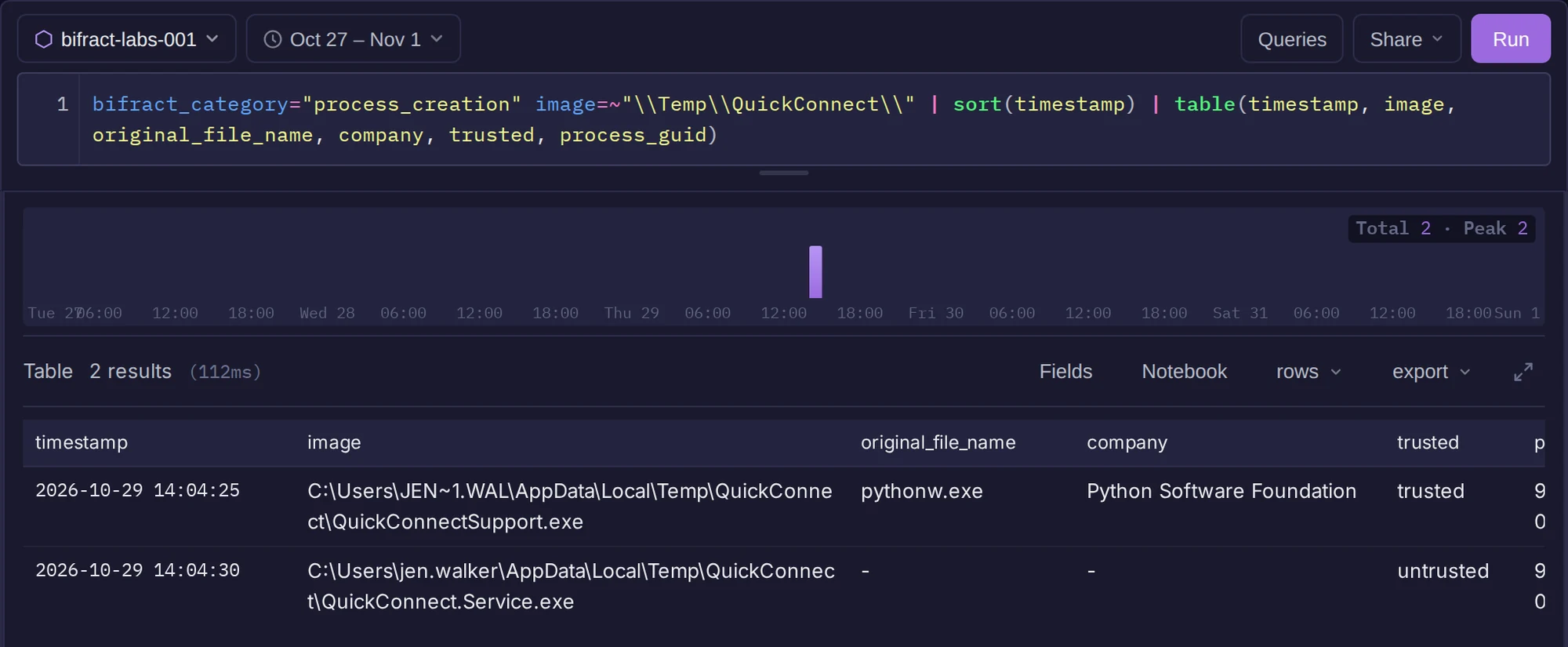
The loader's original file name, publisher and signature.
QuickConnectSupport.exe is really pythonw.exe, published by the Python Software Foundation, with a trusted signature. It's a legitimate signed interpreter running under a support-themed name (T1036, Masquerading). The next process, QuickConnect.Service.exe, has no original file name and isn't signed.
Finding · Q006
The loader's original file name is pythonw.exe.
Hunt every renamed binary at once
Compare each executable's name on disk with its original file name across the whole fleet:
bifract_category="process_creation" original_file_name=* original_file_name!="-" | exe := lower(splitAt(image, "\\", -1)) | ofn := lower(original_file_name) | exe != field(ofn) | groupBy(computer_name, exe, ofn, trusted) | sort(_count)You get about 37 rows. Most are benign (Edge installers, usoclient, wermgr, tar.exe as bsdtar), but quickconnectsupport.exe shows up twice on WS02: once as pythonw.exe and once as rustdesk.exe. Comparing one field to another needs field().
How does Python know what to run? Q007
A portable ("embeddable") Python reads a ._pth file next to the interpreter to decide where to import code from. Change that file and you change what runs at startup.
Sysmon's file create rule didn't log every file tar wrote. But tar sets each file's timestamp back to the one stored in the archive, and Sysmon logs that as event 2 (file creation time changed). Filter out the DLLs to see what's left:
event_id="2" image=$"\\tar.exe" | target_file!=/\.(pyd|dll)$/i | sort(timestamp) | table(timestamp, target_file, previous_creation_utc_time, creation_utc_time)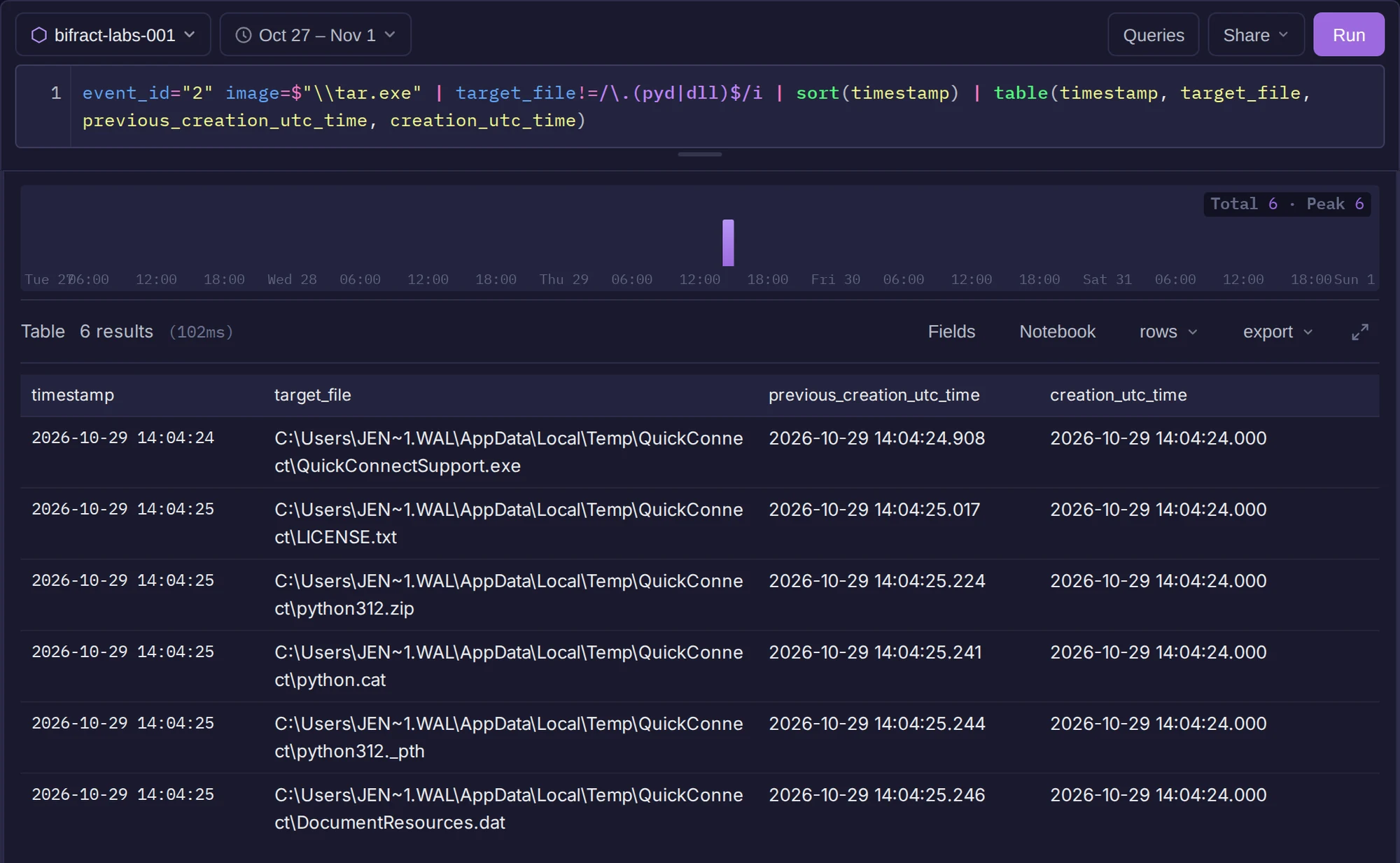
Non-DLL files tar restored, oldest first.
There are six files: the renamed interpreter, LICENSE.txt, python312.zip, python.cat, python312._pth and DocumentResources.dat.
Finding · Q007
The path configuration file is python312._pth.
Not timestomping
Event 2 often catches attackers back-dating files. Here it's tar restoring the archive's timestamps, which happens to every file in the bundle. Event 2 has no bifract_category, so filter it by event_id.
The file that doesn't belong Q008
A stock embeddable Python ships python312.zip, python312._pth, python.cat and LICENSE.txt. One file in the list isn't part of Python: DocumentResources.dat, written right after the ._pth. It's most likely a zip archive with a harmless-looking extension, added to the import path so Python loads the attacker's code from it.
The logs don't show the ._pth contents or a read of the .dat, so this is an inference from the files in the bundle. A full-text search for "DocumentResources" finds only this one event in the whole dataset.
Finding · Q008
The sidecar archive is DocumentResources.dat.
What did the loader start? Q009
ptg() walks the process tree from a process_guid. Follow the loader forward one level:
ptg(start="9D045BEA-5269-6AE3-CC3D-000000001100", direction=forward, depth=1)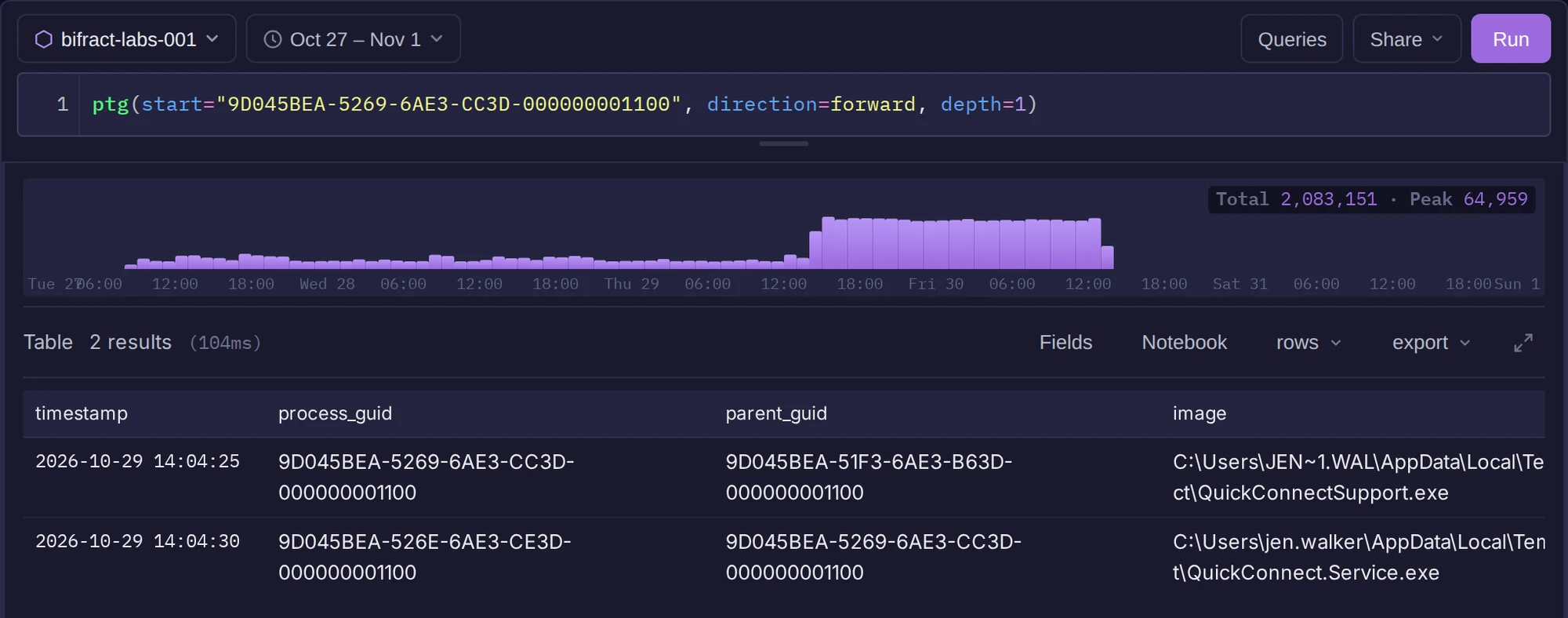
The loader's one child.
Finding · Q009
The loader started QuickConnect.Service.exe at 14:04:30. That's the first foothold.
Give ptg() a direction
For this seed, ptg() with the default direction=both can be very slow. Pass direction=forward (or backward).
See everything it touched
pgr() goes further than ptg(). It rebuilds the process tree, scores each file, network and DNS action by how rare it is on other hosts, and hides the everyday noise. Start it on the loader and draw it with pgraph():
pgr(start="9D045BEA-5269-6AE3-CC3D-000000001100", limit=3000) | pgraph()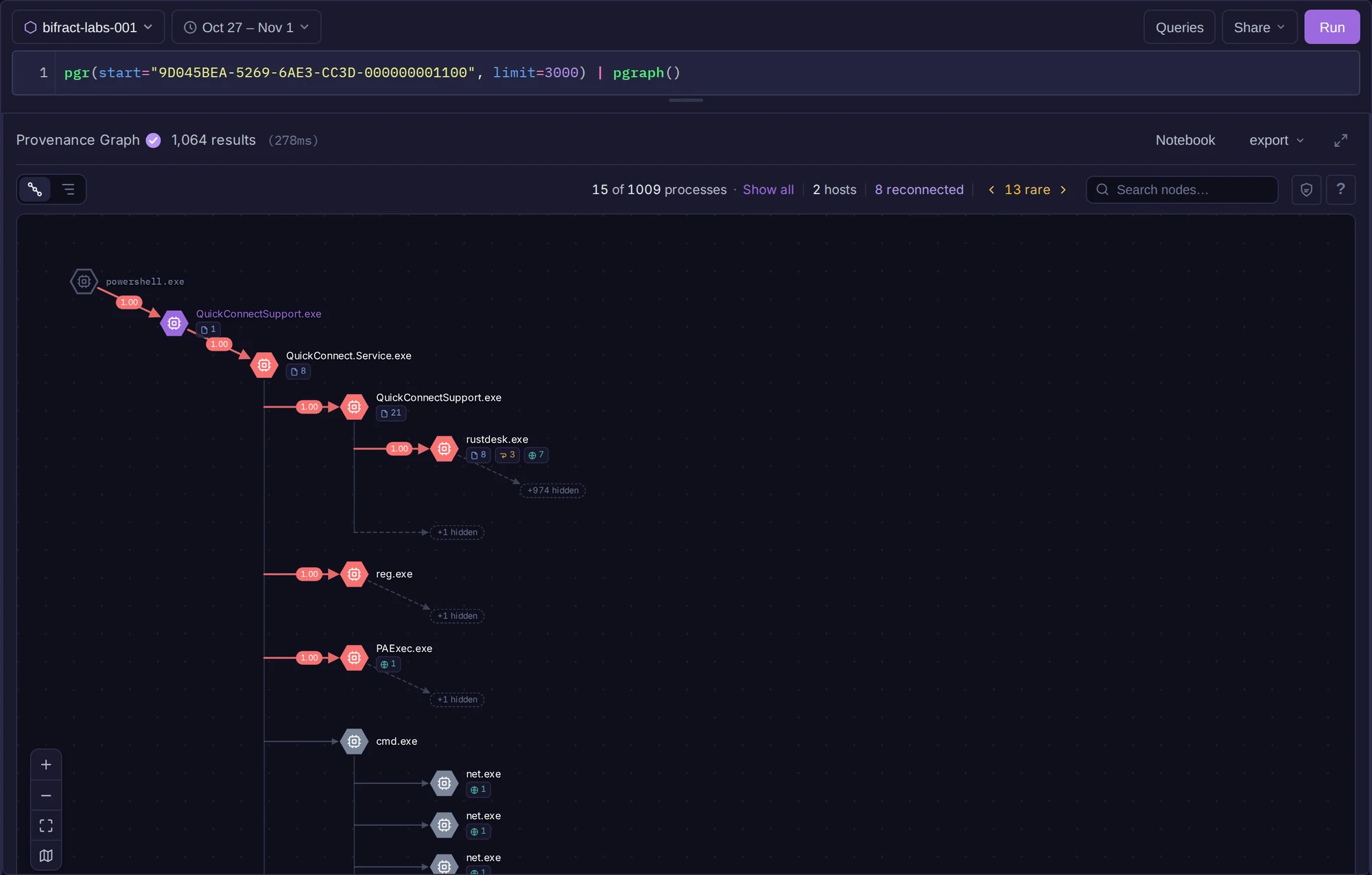
The provenance graph from the loader. Red marks actions rare across the fleet.
Use the ‹ › arrows next to N rare to step through the processes with rare activity. Most of the next four chapters are in this graph: discovery commands, the renamed RustDesk, a registry Run key, a net use loop, and PAExec reaching WS03.
Raise the limit
RustDesk starts cmd.exe about 48,000 times. At the default limit, those repeats can crowd out file and network actions, so this query raises it to 3000.